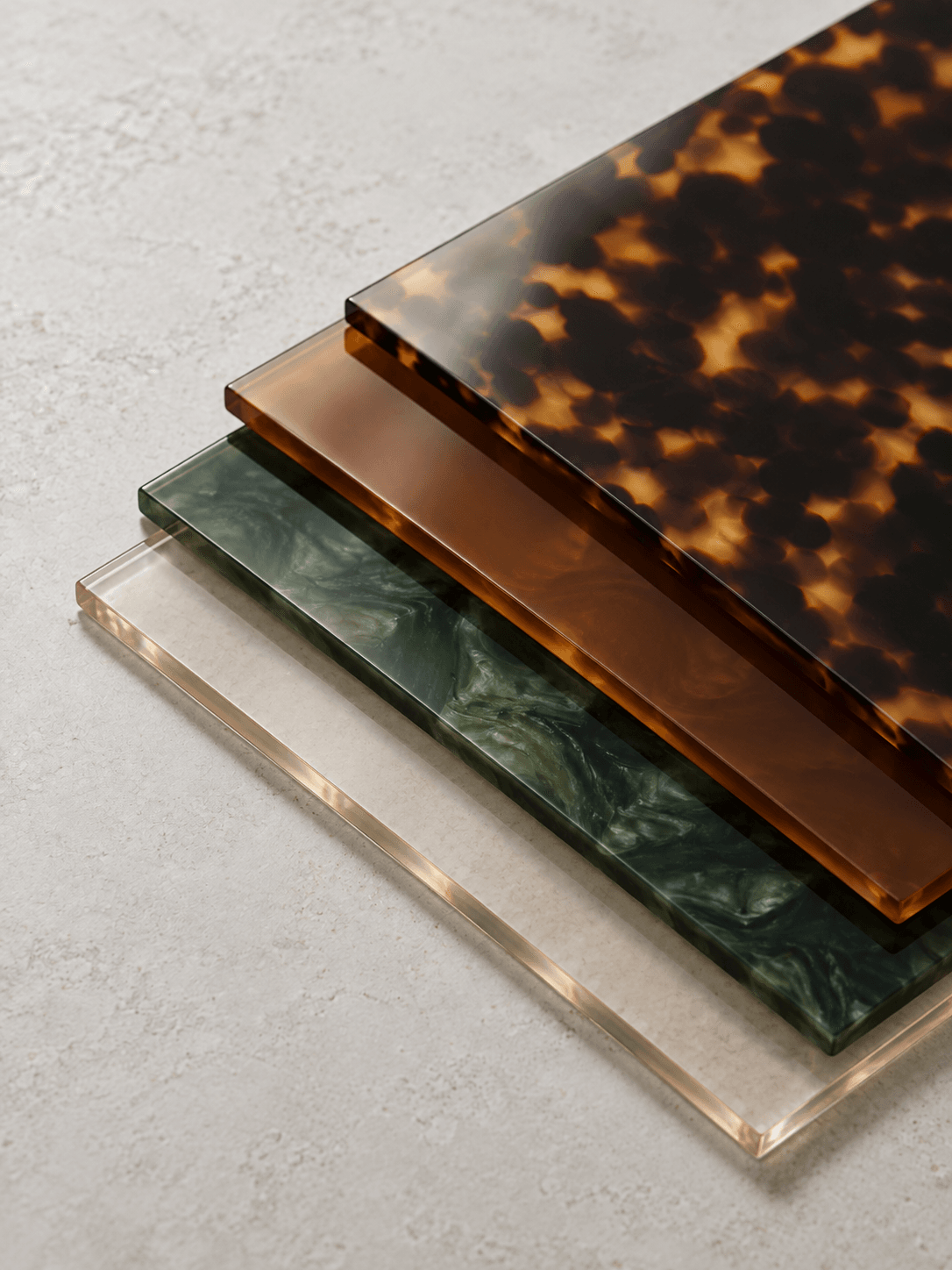
What eyewear brands should compare before choosing frame materials—from appearance and processing to supplier options and production costs.
Better acetate is worth paying for when it delivers something your collection actually needs: the right visual effect, consistent material quality, or better results in production. A higher price or a familiar supplier name, by itself, is not enough. A lower-cost material that meets the same design and quality requirements may be the better purchase.
For an eyewear brand, the useful question is not simply, “Which acetate is best?” It is: “Which material will help us produce the frame we approved, consistently and within budget?”
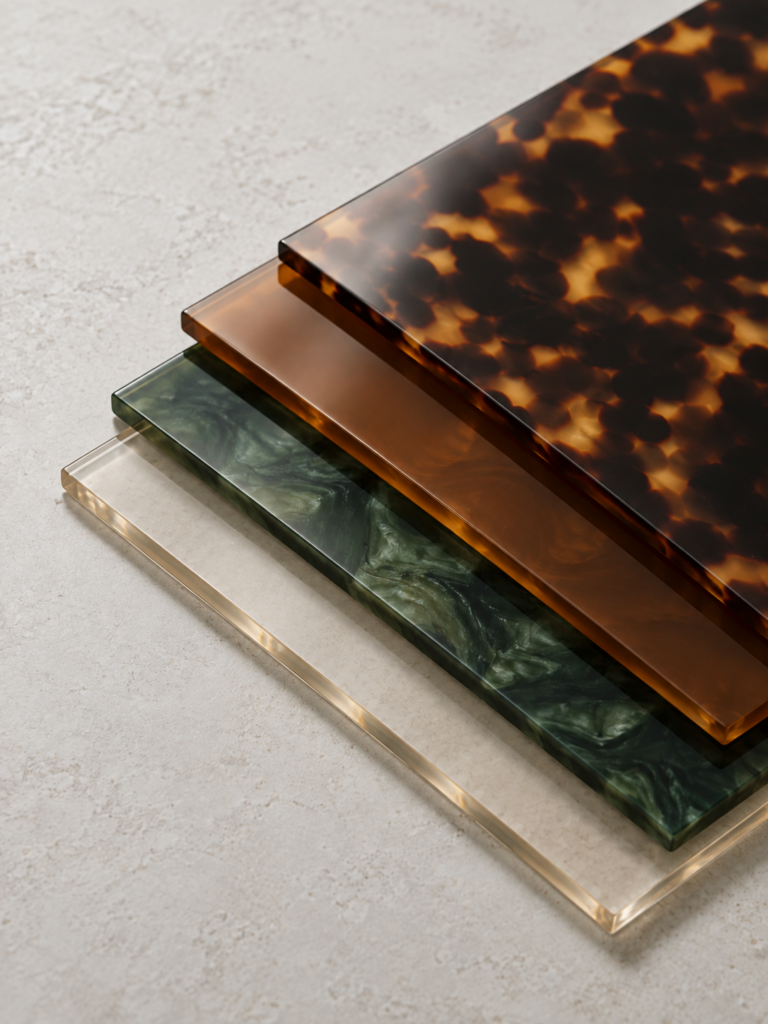
What Does Quality Acetate Actually Mean?
The material discussed here is cellulose acetate sheet used to manufacture eyewear frames. Cellulose acetate is derived from chemically modified cellulose, with plasticizers added to achieve suitable flexibility, toughness, and processing behavior. Its plant-derived origin does not make it plastic-free. Mazzucchelli 1849
Nor does a harder sheet automatically make a better frame. Eastman’s technical information explains that plasticizer levels influence properties such as hardness, rigidity, heat resistance, and impact strength. Improving one characteristic can involve a trade-off elsewhere. 东曼产品目录
For material selection, start with the frame’s requirements. A substantial, sculpted front and a slender optical frame should not be evaluated only by how firm a sample feels in your hand.
Where Material Quality Shows Up
Appearance that matches the design
Look beyond the first impression of a polished color sample.
Check the material for unwanted inclusions, surface defects, and deviations from the approved color reference. Dimensions and pattern consistency deserve attention alongside appearance. Takiron Rowland, for example, identifies size, color, pattern, surface condition, and contamination among its outgoing inspection criteria. タキロン・ローランド
For a tortoiseshell design, agree on an acceptable range of pattern variation rather than expecting every piece to look identical. For a layered frame, review how the colors appear across the front, edges, and temples—not just on the face of the sheet.
Transparency is not a universal quality test, either. Solid, milky, transparent, pearl, printed, and laminated effects are different design options. JIMEI’s published manufacturing information includes several of these approaches; the process name alone is not a reason to classify a material as inferior. 集美123
Good appearance means achieving the intended design—not making every frame clearer, shinier, or more colorful.
Clean results after machining and finishing
A sheet should be evaluated as a frame component, not only as a swatch.
During sampling, inspect machined edges, lens grooves, thin sections, and layered areas. Check whether polishing produces the desired finish without removing important details.
However, chipping or rough edges do not automatically prove that the acetate is defective. Mazzucchelli’s processing guidance identifies material conditioning, tool sharpness, clamping, and feed conditions as factors that can affect machining results. Mazzucchelli 1849
When a problem appears, investigate the material and the process together. Compare candidate materials using appropriate processing conditions, then record the resulting quality, scrap, and rework.
Stability under appropriate handling conditions
Acetate is affected by its environment. Moisture content can influence dimensions and mechanical properties, while forced drying can make the material brittle. Proper conditioning matters; “drier” does not necessarily mean “better.” Mazzucchelli 1849
Ask the factory how the material is stored and prepared for processing. Review finished samples after assembly and any agreed conditioning or testing, rather than approving them solely on their appearance immediately after polishing.
Treat claims such as “never warps” with caution. Request a defined performance requirement and supporting evidence instead.
Comparing Mazzucchelli, Takiron Rowland, JIMEI, and LA/ES
A supplier name is a useful starting point, but the purchasing specification needs to go further.
The comparison below summarizes publicly described materials and manufacturing methods. It is not a head-to-head performance test, a price ranking, or a list of LINGYA OPTICAL’s supply relationships.
| Supplier | What its published information identifies | What to confirm for your project |
|---|---|---|
| Mazzucchelli 1849 | Different formulations, including standard, HX, and M49, alongside block, extrusion, compression, and lamination processes. Mazzucchelli 1849 | The exact formulation, color reference, thickness, and processing requirements—not just the brand name. |
| Takiron Rowland | Extrusion and pressing processes, with inspection of dimensions, color, pattern, surface condition, and contamination. タキロン・ローランド | How the selected sheet performs in your frame geometry and whether the finished appearance meets the approved reference. |
| JIMEI | Extrusion, dry-block, and lamination technologies, with options including multilayers, gradients, tortoiseshell effects, and printed laminations. 集美123 | The specific construction and color code, followed by sample results, availability, minimum quantities, and reorder terms. |
| LA/ES | A technology range that includes extrusion, dry blocking, wet blocking, and lamination. Acetato – Laminati Estrusi Termoplastici | Which material and manufacturing route suit the design, and how the quotation compares under equivalent purchasing conditions. |
These suppliers’ published processes also challenge a common shortcut: treating “extruded” and “block” as automatic labels for low and high quality. Multiple suppliers offer more than one production method. Evaluate the specific material and its suitability for the frame. タキロン・ローランド
For a fair commercial comparison, request the same thickness, a comparable color or pattern, the same quantity, and clearly stated delivery terms. Confirm manufacturing origin through the actual supply documentation rather than inferring it from a brand’s identity.
Without equivalent quotations and sample results, there is no sound basis for declaring one of these suppliers the cheapest, most durable, or best value.
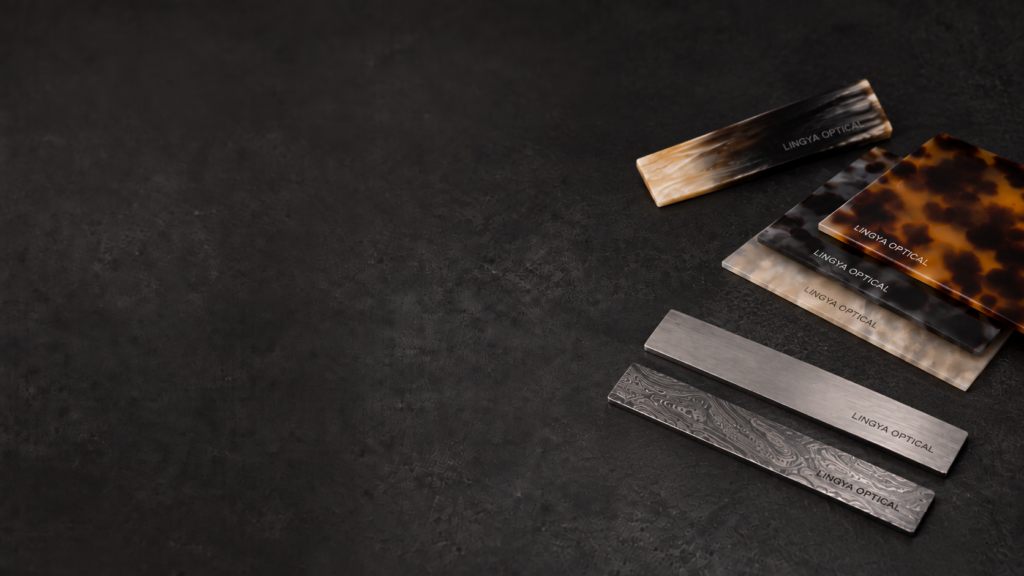
When Is More Expensive Acetate Worth It?
Consider two different development briefs.
A straightforward black optical frame. If two candidate materials both meet the agreed appearance, machining, and finished-frame requirements, compare their total production costs and supply conditions. The higher-priced option should offer a specific benefit to justify the difference.
A sculpted frame with visible color layers. Here, the arrangement and appearance of the layers may be central to the product. Approve a complete prototype, including the beveled edges and temples, before deciding whether the additional material cost produces a meaningful improvement.
Technical support can also form part of the evaluation. Check whether the supplier provides useful processing guidance and documentation relevant to the material being purchased. Mazzucchelli, for example, publishes a dedicated document library, but the relevance of each document still needs to be checked against the selected material and project. Mazzucchelli 1849
Pay more for a demonstrated benefit, not an assumption that the most expensive sheet must produce the best frame.
Compare the Cost of an Accepted Frame—not Just the Sheet
For an internal production comparison, use a consistent calculation:
Production cost per accepted frame = material consumed, processing, and rework costs ÷ frames that pass the agreed inspection.
Include the cost of material consumed by rejected parts, and avoid counting rework twice. This is a production comparison, not a complete selling-price calculation.
Suppose one material costs less to purchase but requires additional sorting, repeated finishing, or more rejected components. Those costs may outweigh the initial saving. Conversely, when a lower-priced material achieves the required result without those additional costs, paying more may provide little practical benefit.
The distinction is important: lower-cost acetate and nonconforming acetate are not the same thing.
An affordable material can be suitable for the job. A material that fails the agreed specification needs corrective action, regardless of its supplier or price.
What to Approve Before Production
Replace “use premium acetate” with a specification that the supplier and factory can actually work to.
Record the supplier, material series, color code, sheet thickness, and agreed tolerances. Keep an approved physical reference, and define acceptable variation for patterned materials.
For the finished sample, review the front, temples, edges, and relevant connection areas. Agree on the required appearance and functional checks, then establish how production and later reorders will be compared with the approved standard.
The goal is not to eliminate every natural-looking variation in a pattern. It is to decide which differences belong to the design and which are unacceptable.
The right acetate is the material that delivers the approved frame reliably, at a cost that makes sense for the collection.
Developing an acetate eyewear collection? Share your design, reference sample, target colors, and expected order quantity with LINGYA OPTICAL to discuss material selection and manufacturing requirements before sampling.
Supplier names are included for identification and comparison based on public information. Their inclusion does not imply affiliation, authorization, or endorsement of LINGYA OPTICAL.