IP vs. electroplating—and how to choose a finish that fits your frame, performance requirements, and budget.
The difference between two finishing quotes is rarely just the color. Surface preparation, coating materials, the layers beneath the visible finish, and production requirements all belong in the comparison. IP can be a strong option for a hard, wear-resistant metallic surface, while electroplating offers choices such as specific precious-metal deposits and multilayer finishes. Neither process name, on its own, tells you which is better value. 欧瑞康
For an eyewear brand, the useful question is straightforward: What does the additional cost buy—and how will we confirm it on the finished frame?
Where the Price Difference Comes From
Surface preparation and underlying layers
Start with what happens before the final color is applied.
A finishing specification may include polishing, cleaning, surface activation, and intermediate layers. Some substrates also require electroplated base layers before receiving a decorative PVD coating. That means an “IP finish” may involve more than one coating process. Sharretts Plating Company
Ask suppliers to describe the complete treatment, from the frame material to the outermost layer. Comparing one quote that includes all preparation with another that covers only the final coating will not give you a meaningful price comparison.
The coating material—not just its color
A gold-colored finish does not necessarily contain gold. Certain decorative PVD coatings achieve gold tones through their chemical composition. Electroplating can instead deposit actual gold or gold alloys. Similar-looking samples can therefore represent different material specifications. hauzertechnocoating.com
For a precious-metal finish, confirm the deposited metal, its composition, and the specified thickness. For the same composition and coated area, a thicker deposit requires more material. That is one reason wet electroplating should not automatically be treated as the cheaper option.
Part handling and batch requirements
Vacuum coating requires suitable fixtures and controlled positioning. Parts may rotate during deposition to improve coverage, and unfamiliar geometries can require additional fixture or process development. ionbond.com
When comparing quotes, ask whether setup, special fixtures, and minimum batch charges are included. For a small order, check how those charges are allocated across the quantity. For several colorways, confirm whether each color requires a separate production batch.
Color matching and consistency
An established color and a newly developed shade are different production requests. Decorative PVD suppliers can develop custom colors, but matching the target and reproducing it consistently are part of the work—not simply a different color name on the order. hauzertechnocoating.com
Agree on a physical reference sample, the viewing conditions, and an acceptable color variation before approving production.
There is no useful blanket rule that IP should cost a fixed percentage more than electroplating. Request both options against the same frame design, quantity, color reference, and acceptance requirements. Then ask the supplier to explain the difference.
IP vs. Electroplating: What Actually Changes?
IP, or ion plating, is one type of physical vapor deposition (PVD). It forms a thin coating in a vacuum rather than in a liquid bath. Depending on the coating composition, it can provide metallic color with a hard, wear-resistant surface. PVD is the broader category; it also includes processes such as sputtering. 欧瑞康
Electroplating uses an electric current to deposit metals or alloys from a liquid solution. Different deposits can provide decoration, protection, or a base for subsequent layers. The result depends on the chosen materials and process conditions, not simply on the fact that it is a wet process. Sharretts Plating Company
The two methods are not always alternatives. They can be combined in the same finishing system, with an electroplated base beneath a PVD surface layer. That is why “IP or electroplating?” is only the starting point of a specification. ionbond.com
What a Color Sample Does—and Does Not—Tell You
A sample helps establish appearance. It does not, by itself, establish durability.
Even the appearance depends on more than coating chemistry. Thin decorative PVD coatings can preserve the texture underneath them, so polishing, brushing, and other surface preparation influence the finished look. A brushed sample and a highly polished sample are not a fair comparison of coating methods alone. ionbond.com
For sample approval, keep three questions separate:
Does it look right? Compare color, gloss, texture, and consistency between the front and temples.
Does it stay attached? Evaluate adhesion and, where appropriate, the finish after the component flexes through its intended range.
Does it withstand the intended use? Agree on relevant abrasion, perspiration, and corrosion checks, with defined conditions and acceptance criteria.
These assess different aspects of performance. Eyewear finishing specifications may include separate bending, adhesion, and corrosion tests; a satisfactory result in one does not establish performance in all the others. アイテック / EYETEC
Also inspect less visible areas, including rim interiors and surfaces near connections. PVD coverage depends on geometry and positioning, so the front-facing surface is not the only area worth reviewing. ionbond.com
Titanium Frames Need a Material-Specific Approach
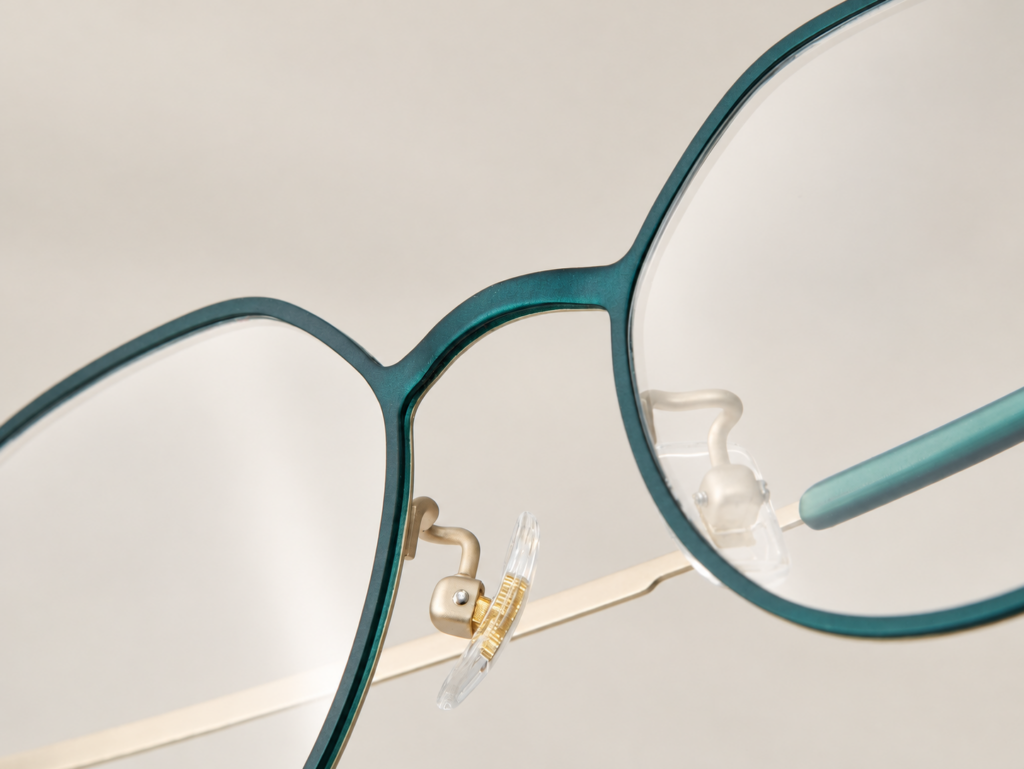
Do not assume that a finishing process developed for another metal can be transferred unchanged to pure titanium or beta titanium.
Titanium surface preparation and coating adhesion require particular attention. Eyewear finishing research has documented differences in adhesion and appearance between titanium alloys, along with coating problems when temples are bent. The process needs to suit the actual material. アイテック / EYETEC
For flexible beta titanium temples, review the finish on production-shaped parts—not only on a flat color sample. Ask the finishing supplier to confirm that deposition and any subsequent curing temperatures are compatible with the alloy and its condition. Substrate stability at the processing temperature is a relevant PVD selection factor. ionbond.com
The approval should cover the finished component’s appearance and required movement together.
How to Choose a Finish for Your Collection
Start with the product requirement, then compare suitable processes. The following are directions for sampling, not a ranking of “premium” versus “basic.”
| Your priority | What to evaluate | What to confirm before approval |
|---|---|---|
| A metallic finish with strong surface wear resistance | A suitable hard IP/PVD coating | Color, adhesion, coverage, and agreed wear-test performance |
| A specified gold or other precious-metal layer | An appropriate electroplating system | Deposited metal, composition, thickness, and underlying layers |
| A cost-controlled first production run | Both routes quoted against the same brief | Preparation, setup charges, quantity per color, and total finishing cost |
| Flexible titanium components | A process matched to the alloy and component | Processing temperature, adhesion, and finish behavior during intended flexing |
These choices follow the different capabilities and material requirements of decorative PVD and electroplating; the actual coating specification still needs to be confirmed for the frame. ionbond.com
Before placing the order, agree on the physical finish reference, the relevant material and layer specifications, and how the finished frames will be checked. A description such as “premium IP gold” leaves too much open to interpretation.
Pay more when the additional work meets a defined product requirement—not simply because one process sounds more advanced.
Developing a metal eyewear collection? Share your frame material, target finish, color reference, and expected order quantity with LINGYA OPTICAL to discuss finishing options before sampling.